


Faune et flore en Clarée
Partez à la découverte de la nature préservée de la vallée de la Clarée. Au détour d’un chemin, vous rencontrerez peut-être l’un des habitants de la montagne. Prenez le temps à l’observation, à la contemplation de ces instants éphémère. Soyez discret et respectueux de cette nature pour la protéger.
Faune et flore en Clarée
Vous découvrez la vallée de la Clarée ? Soyez attentif à la faune et la flore en Clarée, qui ne cessera jamais de vous surprendre.
Une biodiversité à contempler au fil des saisons, la faune et flore en Clarée est préservée grâce aux nombreuses actions menées par Natura 2000 pour préserver cette vallée sauvage et authentique.
protected species reintroduced in the Alps, the ibex
By the end of the 19th century, the ibex had virtually disappeared from the French mountains.
This majestic mountain dog, which can weigh up to 110 kg, was successfully reintroduced to the Cerces massif in 1959 - 1960.
An annual count tracks the development of the Cerces ibex. Some can be seen around Lac des Béraudes, towards Les Rochilles, Chardonnet and Queyrellin, or at the foot of Pointe des Cerces.
The annual count in spring 2019, to mark the 60th anniversary of the reintroduction of the species in the Briançonnais, gives us an estimate of 300 ibex in the Cerces.


the chamois, runner of the peaks of the clarée
Everywhere in the valley, you'll be on the lookout for that little ungulate: the chamois.
You can usually spot it between 2000 and 3000 m altitude, grazing peacefully from the Acles valley above Plampinet to the highest massifs in the upper Clarée or Etroite valleys.


adapting to winter: wildlife surviving a snowy winter
The hibernatingmarmot spends the winter deep in its burrow. This long wait is made possible by major physiological changes: body temperature drops, heart rate increases and breathing decreases.
Other species use "moulting" or "camouflage" to protect themselves in winter, such as the mountain hare, which turns snow-white in winter, making it harder for predators to spot. The ermine and the rock ptarmigan also share this strategy of concealment in the winter landscape.
To find out more about how wildlife adapts to winter, click here.
many species of flowers protected in Clarée


In the forest, the "little pink trees" - rhododendrons - give way to the gentle delicacy of liverwort, while Martagon lilies dot the undergrowth.
White with Narcisses or Driades, yellow with Trolles or Hélianthèmes, pink with Joubarbes or Oeillets sauvages, purple with Campanulas or Raiponces, blue with Gentianes or Myosotis, meadows and mountain pastures become the painter's palette.
Arnica and Benoîte unfurl their corollas in sheep country, while the scree slopes are adorned with sweet Alpine Linaria and Glacier Buttercup.
Perhaps you'll be lucky enough to come across Edelweiss or Génépi on the windy slopes and mineral ridges.

picking and selling of wild flora
For some species, picking is regulated: you can only pick what's in an adult's hand. Removal, destruction and sale are prohibited. The plants concerned are Arnica, Black Genepi, Glacier Genepi, Yellow Genepi, Edelweiss and Martagon Lily.
For others, they are only banned for industrialization purposes, such as Blueberry or Yellow Gentian.
Lastly, strict rules prohibit picking, as is the case for Sphagnum, Orange Lily, Woolly Genet, Napel and Paniculate Wolfsbane, and Venus's Slipper...
some of the elements the richness of this site
Pin mugo is a coniferous tree closely related to Pin à crochets, found on windy ridges, rocky slopes and certain avalanche paths. This species is very rare in France, known only in the Alpes-Maritimes and Hautes-Alpes departments.
The European Barbastelle is a forest bat. It finds refuge in tree cavities, under loose bark or even behind the shutters of houses. In France, all bat species are protected.
The Austrian Cracocephalus is a very rare labiatae with intense purple flowers that thrives on certain steep, sunny slopes.
The Venus hoof be etle lives in limestone mountain forests. Its existence depends on the presence of a fungus and a specific bee that ensures its pollination.
Source: Natura 2000 La Clarée
You mightalso like this

In the wood of the little owl
To marvel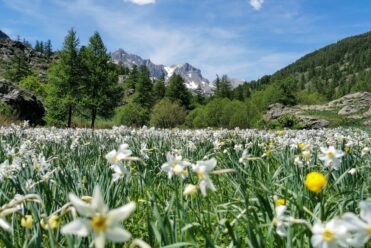
Nature Science Environment Network
Scientific tourism